
 Last Updated:
How to Use a Compass - Lesson Two
Using the Compass with a Map
This is a very important lesson, and you should learn it well. It's when you use both compass and map that the compass is becomes a truly valuable tool. With both items in your possession, you will be able to navigate safely and accurately in terrain you've never been before without following trails. But it'll take some training and experience.
We won't cover map reading here, but the lesson will be useful if you have a sense of what a map has to offer.
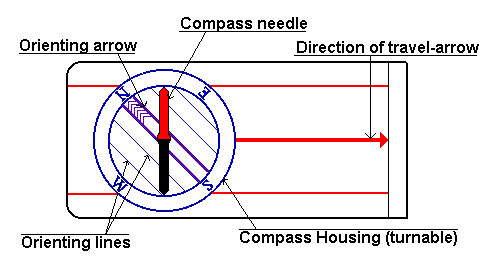
Here is our compass again. The principles are much the same as in the first lesson, but this time you will be using the map and compass, rather than your intuition, to tell you which way is correct.
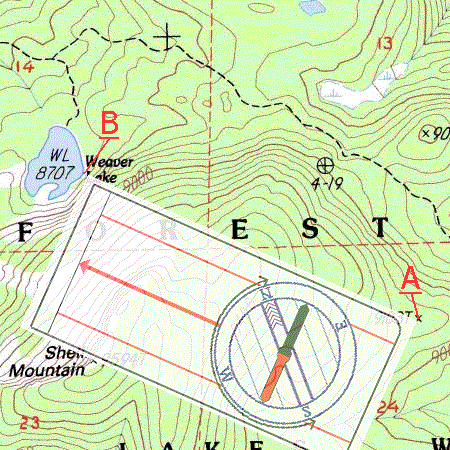
Here's a sample map. Let's assume you want to go from the hilltop at Point A to the lake shore at Point B. Of course, to use this method successfully, you'll have to know you really are on the hilltop at Point A.
Lay the map out with north at the top and put your compass on the map so that the long edge of the compass runs through Point A. Line up Point B somewhere along the same edge of the compass, as show here. Of course, you could use the direction arrow itself, or one of the parallel lines, but it's usually more convenient to use the edge of the compass.
At this point, some instructors say that you should use a pencil or marker and draw a line along your course. I would recommend against it. It offers no real enhancement in accuracy and any drawings or marks you make on the map may hide important details.

Time to be careful again! The edge of the compass, or rather the direction of travel arrow, must point from Point A to Point B! Again, if you do this wrong you will walk off in the exact opposite direction of what you want. Take a second look and make sure you have it right. Beginners often make this mistake as well.
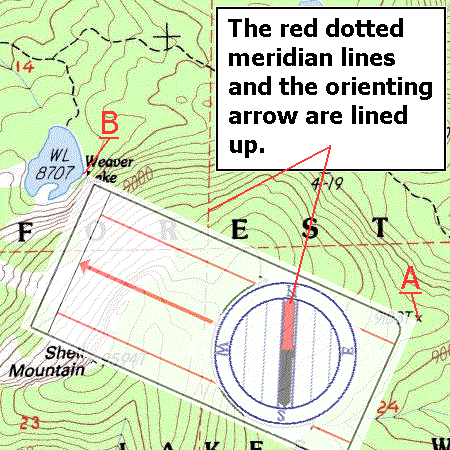
Keep the compass steady on the map. Now locate north on the map. What you are going to do next is align the orienting lines and the orienting arrow that are within the compass housing with the meridian lines of the map. Those are the lines running north and south. While you have the edge of the compass carefully aligned with Point A and Point B, and the direction of travel arrow pointing toward Point B, turn the compass housing so that the orienting lines and the orienting arrow in the compass housing are aligned with the meridian lines on the map. The orienting arrow should be pointing north. During this process, it doesn't matter what happens to the compass needle.
There are a couple of serious mistakes that can be made here. Let's take the problem with going in the opposite direction first. Be absolutely certain that you know where north is on the map, and be sure that the orienting arrow in the compass housing is pointing toward north. Normally, north is at the top of the map. The easiest possible mistake is to point the orienting arrow to south on the map.
Remember to keep an eye on the the edge of the compass. If the edge isn't aligned with Point A and Point B when you have finished turning the compass housing, you will have an error in your direction, and it can take you off your course.
When you are sure you have the compass housing and the two arrows aligned correctly, you may take the compass away from the map. Now read the bearing, in degrees or direction, off of the compass housing from where the housing meets the direction of travel arrow.
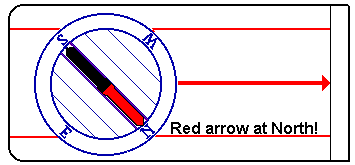
The final step is similar to what you did in Lesson One. Hold the compass in your hand. Keep it level so that the compass needle can turn. Then turn yourself, your hand, the entire compass, everything, and turn until the compass needle is pointing toward north on the compass housing and is aligned with the orienting arrow and lines inside the compass housing.
The easiest and biggest mistake is again to let the compass needle point towards the south. The red part of the compass needle must point at north in the compass housing, or you'll walk off in the opposite direction.
It's nearly time to go. But to make sure you're walking in the right direction with some degree of accuracy, you'll need to do one more very simple thing.
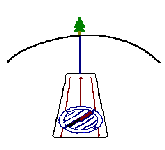
Hold the compass in your hand, with the compass needle pointing toward north and well-aligned with the orienting arrow. Then aim, as carefully as you can, in the direction the direction of travel arrow is pointing. Fix your eye on some special feature in the terrain as far as you can clearly see in that direction. Then simply hike to that spot. Of course, you should check your accuracy as you're walking. Keep the compass level and in front of you and glance at it from time to time to make sure you're still going in the right direction. Remember, the compass needle must point toward north on the compass housing while you are walking!
If you're in a dense forest, you might need to aim and hike several times in succession, choosing several intermediate points between yourself at Point A and your destination at Point B.
Now, a quick summary of what you learned in this lesson:
- Place the compass on the map and align one edge of the compass with the starting and finishing points.
- WIth the compass still on the map, rotate the compass housing until the orienting arrow and lines point toward N on the map.
- Take the compass off of the map and turn yourself and the compass until the red end of the compass needle points toward north on the compass housing and it is aligned with the orienting arrow.
- Follow the direction of travel arrow on the compass, keeping the compass needle pointing north and aligned with the orienting arrow on the housing.
After a bit of practice, there's at least one more thing you need to learn about: declination. That is the topic for Lesson Three.